Rain in Tokyo doesn’t slow the city down.
It changes its rhythm.
It softens its edges.
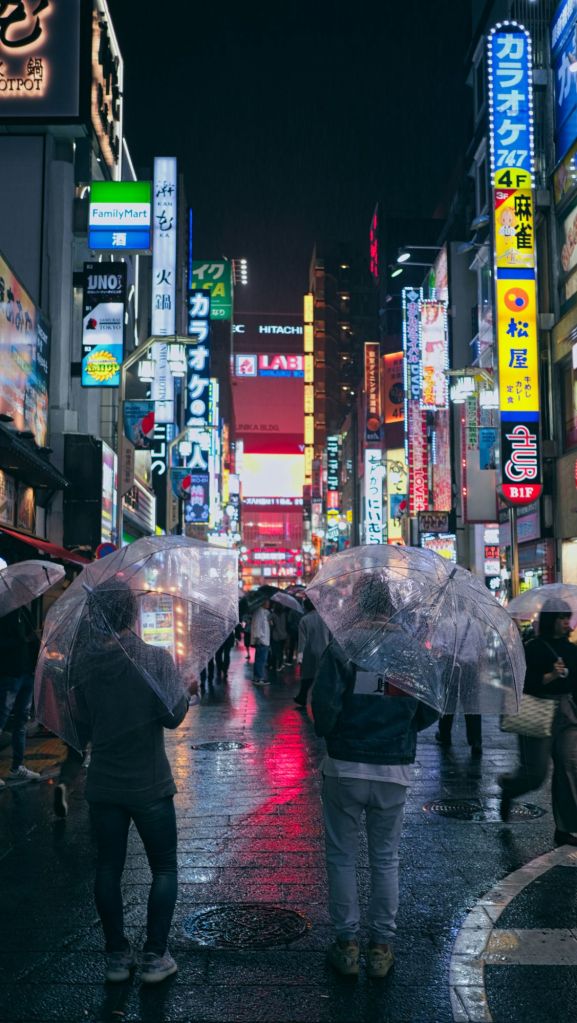
It makes everything glisten, like the whole city has been wrapped in a thin layer of glass. And in that shift, something beautiful happens: Umbrellas appear. And Tokyo begins to speak in a new language.
Clear umbrellas form a silent choreography.
At rush hour, thousands move in step—transparent domes weaving through crossings without touching. No bumping. No collisions. Just small micro-adjustments made with grace and spatial awareness. It’s a quiet ballet of trust.
Convenience store umbrellas are the unspoken uniform. For 500 yen, you can be part of the collective. No logos. No bright colors. Just a clear view of the world above you, speckled with rain. Some people even leave them at subway stations or storefronts for the next person to use. There’s no need to claim ownership. The umbrella becomes communal.
In neighborhoods like Shimokitazawa or Nakameguro, the scene shifts:
Locals carry well-loved umbrellas, fabric ones with curved wooden handles, or small collapsible ones tucked into tote bags.
They walk slowly. With intention.
Shops prop umbrellas outside in narrow stands, where they wait patiently, dripping, until called back into service.
Rain brings softness to the city.
People speak more quietly.
Street sounds are muffled.
Bicycle bells are gentler.
You begin to hear other things, your own breath, the splash of a cab tire, the melodic tap of water on pavement.
Umbrellas become more than protection.
They are signals.
They’re shields.
They’re extensions of the self.
A tilted umbrella says:
“I’m making space for you.”
Two umbrellas almost touching says:
“We’re walking together, even if we’re silent.”
An umbrella left open at the café door says:
“I’ll be back.”
In Tokyo, even in the rain, nothing is wasted.
Not a movement.
Not a drop.
Not a moment of beauty.
You just have to listen.
Even to umbrellas.
 Tokyo Frame
Leave a comment